Just when everyone is taking Summer siestas and there seems very little news around to talk about. Along comes a new Direct Conversion 40m Transceiver kit from Australia.
The MDT DSB kit is manufactured by Ozqrp, capable of 2W PEP, it has a full swinging VFO 7.090MHz - 7.130MHz or 7.050MHz - 7.110MHz. A complete kit of components including PCB, and case for $80 (Aus) less than £40 UK plus carriage. Which worked out at $12.50 (£6) posted to the UK, when I did a quick trial purchase test and popped it into the shopping trolley on the Ozqrp website.
Further details and a well written comprehensive manual can be found at: http://www.ozqrp.com/MDTindex.html
Update 4/7/15
Peter VK3YE has now done an excellent video review of the MDT 7MHz DSB:
https://www.youtube.com/watch?v=2OtZeFkb1xw
Sunday, 28 June 2015

Saturday, 30 May 2015
The Reverend reviewed
May brought Radcom the RSGB's monthly magazine for its members. It normally takes me about a month to hunt out the bits what I want to read, then it gets filed in the pile with the rest. A quick flick through is always the norm, this months (June issue), I was perusing through at great speed over my evening tea, I hit the bi monthly QRP page written by the Rev George Dobbs (G3RJV). What is this, my name and callsign suddenly grabbed me! George was reviewing my Blog and items I had pulled to the front from the Chinese and others.

History lesson: The first time I came to know of a George Dobbs, was back in the mid 1970s when I was a schoolboy at around the age of 12. I built his project Making A Transistor Radio published in a Ladybird book. A three transistor germanium circuit that was slowly put together in stages from a crystal set, to a fully working regen radio. Built without a soldering iron, perhaps he didn't want us to burn our fingers? Components clamped down under screws and screwcups on a piece of wood. The radio worked first time and was the first electronic project I ever built. At the time I didn't know much about George Dobbs, only 20 years or so in the late 1990s, I would return back to the book and discover that this was the G3RJV George Dobbs associated with the G-QRP club he formed in 1974. Since then, George has gone on to write many QRP related books, monthly insert Carrying on the Practical Way in Practical Wireless, and of course QRP in Radcom and a few others.
So it was an honour to find he had devoted his entire QRP page over to my blog. My wife has got fed up with me by now picking up and down Radcom every five minutes and reading the page over and over again. She said of course your going to blog it, you bet sure I am!
George starts his review of my blog explaining the name "The Font of all Knowledge" and how linguistic scholars that make up half of the RSGB would lay me open to scorn for using the name Font, but how Oxforddictionaries.com claim households are split over the word scone. Of course being a man of the cloth he would know from the amount consumed at the tea parties he has resided over at the Vicarage over the years of his service. The real secret is I take no applause for the name, this I give over to my linguistic friend, scholar, and blogger Roger G3XBM, who is the one whom is responsible for thinking it all up. Before I started my blog I was passing him over information "and still do" about useful links that could prove valuable to be included in his blog. Roger refered to me as the Font of All Knowledge, so I decided to use this when I created my blog late last year.
I now hope that puts peoples minds at rest where the name came from.
Once George has made every one happy, and comfortable, with the name and the importance of its place within the hobby. He then continues forward taking a look at the items I have reviewed, the pixie kit which G3XBM also picked up on and built one.
The Oscilloscope Kit, I recently noted and passed the information over to G3XBM:
http://www.banggood.com/DIY-Digital-Oscilloscope-Kit-Electronic-Learning-Kit-p-969762.html
PSDR from Michael Colton:
http://g1kqh.blogspot.co.uk/2014/10/pdsr-from-michael-cotton.html
I have been very happy with what I have seen G3RJV write, and I am glad the blog continues to score many daily hits from Amateurs around the world. Of course its up to me to find things new, this will continue, when I see something good, and of value, along with other aspects of the hobby I am involved in.
Thank you G3RJV for bringing this to the forefront of Radcom, and thanks to G3XBM for creating the name "The Font of all Knowledge" Swoon! (I only went to a Comprehensive school that got burnt to the ground twice in 4 years while I was being educated there.)
Thanks to Graham G3MFJ for supplying the photo.

History lesson: The first time I came to know of a George Dobbs, was back in the mid 1970s when I was a schoolboy at around the age of 12. I built his project Making A Transistor Radio published in a Ladybird book. A three transistor germanium circuit that was slowly put together in stages from a crystal set, to a fully working regen radio. Built without a soldering iron, perhaps he didn't want us to burn our fingers? Components clamped down under screws and screwcups on a piece of wood. The radio worked first time and was the first electronic project I ever built. At the time I didn't know much about George Dobbs, only 20 years or so in the late 1990s, I would return back to the book and discover that this was the G3RJV George Dobbs associated with the G-QRP club he formed in 1974. Since then, George has gone on to write many QRP related books, monthly insert Carrying on the Practical Way in Practical Wireless, and of course QRP in Radcom and a few others.
So it was an honour to find he had devoted his entire QRP page over to my blog. My wife has got fed up with me by now picking up and down Radcom every five minutes and reading the page over and over again. She said of course your going to blog it, you bet sure I am!
George starts his review of my blog explaining the name "The Font of all Knowledge" and how linguistic scholars that make up half of the RSGB would lay me open to scorn for using the name Font, but how Oxforddictionaries.com claim households are split over the word scone. Of course being a man of the cloth he would know from the amount consumed at the tea parties he has resided over at the Vicarage over the years of his service. The real secret is I take no applause for the name, this I give over to my linguistic friend, scholar, and blogger Roger G3XBM, who is the one whom is responsible for thinking it all up. Before I started my blog I was passing him over information "and still do" about useful links that could prove valuable to be included in his blog. Roger refered to me as the Font of All Knowledge, so I decided to use this when I created my blog late last year.
I now hope that puts peoples minds at rest where the name came from.
Once George has made every one happy, and comfortable, with the name and the importance of its place within the hobby. He then continues forward taking a look at the items I have reviewed, the pixie kit which G3XBM also picked up on and built one.
The Oscilloscope Kit, I recently noted and passed the information over to G3XBM:
http://www.banggood.com/DIY-Digital-Oscilloscope-Kit-Electronic-Learning-Kit-p-969762.html
PSDR from Michael Colton:
http://g1kqh.blogspot.co.uk/2014/10/pdsr-from-michael-cotton.html
I have been very happy with what I have seen G3RJV write, and I am glad the blog continues to score many daily hits from Amateurs around the world. Of course its up to me to find things new, this will continue, when I see something good, and of value, along with other aspects of the hobby I am involved in.
Thank you G3RJV for bringing this to the forefront of Radcom, and thanks to G3XBM for creating the name "The Font of all Knowledge" Swoon! (I only went to a Comprehensive school that got burnt to the ground twice in 4 years while I was being educated there.)
Thanks to Graham G3MFJ for supplying the photo.
Thursday, 23 April 2015
Quality control or lack of?
Amateur Radio has taken a back seat over the last few weeks with various family problems.
However yesterday, I had a bit of spare time and I was all revved up for testing a Baofeng with its battery eliminator. This is the part that takes the place of the HT battery pack and slides on the back of the radio instead of, providing regulated power from the car battery cigar lighter socket, in essence you make yourself a cheap and cheerful mobile rig.
I needed to just test it all out and check that it worked before fitting, and the MP-304 power supply which I had recently bought was still sitting on the dining room table in its box, handy for a few Volts so I thought?


Cased back up, I was then back to the point where I had started at a couple of hours earlier, testing the Baofeng:
However yesterday, I had a bit of spare time and I was all revved up for testing a Baofeng with its battery eliminator. This is the part that takes the place of the HT battery pack and slides on the back of the radio instead of, providing regulated power from the car battery cigar lighter socket, in essence you make yourself a cheap and cheerful mobile rig.
I needed to just test it all out and check that it worked before fitting, and the MP-304 power supply which I had recently bought was still sitting on the dining room table in its box, handy for a few Volts so I thought?
Switching
on the MP-304, there was no deflection of the meter, (meter switch was in the correct Volts position)? I got
the DMM out, and measured the output, plenty of Volts, but still no
indication on the Power supply analogue meter?
Should I return it? No chance, with all the hassle of someone having to wait in for the courier to collect, it had got to be worth a look. Anyway, I used to test power supplies by the hundreds, when I worked in the industry, so I did have a good chance maybe?
Quick investigation
required! Took off the top of the case and I was inside, no going back now. First I measured at the rear of the meter terminals with
the DMM, no Volts, nothing on the rear of meter switch that changes between Amps or Volts either. This then leads us back to the
plug that plugs into CN2 on the control PCB. Just as I was about to measure at this
point, I could see the Blue wire (I have marked it with a small red arrow above) was raised, with its termination tag in the plug sticking out, I unplugged the whole skt from CN2, and the Blue
terminal had not been pushed home in the plug in the factory, a smart push and
it clicked in place. Plugged it back into the PCB socket and switched on, and the meter then sprung
into life!
It does make me wonder
if the Chinese really test this stuff in the factory? Time and time again I have come across problems with Chinese equipment like this, which should really be sorted in the factory before shipping, I don't believe QA exists? The problem here is, the dealer gets a bad name, and really it isn't his fault, he buys in a pallet load, one or two get put out for demonstration, and then the rest are stored ready to be shipped out in the original sealed boxes they come in.
After fixing this, it did however give me the chance to have a good look inside and see what it was made of :
Build quality really wasn't too bad, a nice hefty transformer feeding a quality bridge rectifier, control board (which I have already mentioned), that sets up the limits and then drives the outputs. A good quality heatink blown at by a fan, which is triggered by a stat when the temp gets to a certain level.
Cased back up, I was then back to the point where I had started at a couple of hours earlier, testing the Baofeng:
Wednesday, 8 April 2015
The Pixie money game!
A couple of months ago my friend and Blogger G3XBM was into buying Pixie kits from China, he thought he had bought a bargain for the £7.00 he paid for the kit? Shortly afterwards I found the kits at around a couple of Pounds lower than Roger had bought his for. But this was short lived, a week or so later Roger blogged that Andy Cutland had found them for £3.19 pence, this undercut my price yet again by nearly £1.50!!
Well the story continues!! I have now found the Pixie kits cheaper yet again!!! The complete kit as above (inc PCB components and Xtal), all for a penny pinching £2.89p ($4.30 US), and the more you buy the cheaper it gets! Oh yes I forgot the price "Includes" shipping!!
You could buy several kits without busting the bank, and put them on different Bands with Xtal and small mod of low pass filter changes.
Is this now the cheapest Transceiver kit in the world, or can anyone find them cheaper still??
Well the story continues!! I have now found the Pixie kits cheaper yet again!!! The complete kit as above (inc PCB components and Xtal), all for a penny pinching £2.89p ($4.30 US), and the more you buy the cheaper it gets! Oh yes I forgot the price "Includes" shipping!!
You could buy several kits without busting the bank, and put them on different Bands with Xtal and small mod of low pass filter changes.
Is this now the cheapest Transceiver kit in the world, or can anyone find them cheaper still??
Sunday, 29 March 2015
Binding up!
The normal good old British early Spring wet weather, had stopped any Sunday outside activity, even the cat was having non of it, she was well tucked up after her lunch. Nothing interested me on the television, a boring afternoon ahead or maybe a sleep in the chair?

I remembered there were 2 years worth of Practical Wireless magazines and a few Sprats scattered over the house. 14 were together, 2 were stuck in a drawer by the bed, and the rest were eventually found mixed up with several other piles of junk, which had been dumped together when the XYL had been on one of her recent mad cleaning rounds.

Someone had got me the binders for a present last year, again they took a bit of searching for? But I eventually found them, and set to work. After an hour or so, all were now together sorted and bound, ready for the bookshelf a real professional job!


I like to keep my magazines bound together, making quick reference easy when I want to go back to an article. Todays effort will help with a bulk of projects on the list which you will hear about in the future .
I remembered there were 2 years worth of Practical Wireless magazines and a few Sprats scattered over the house. 14 were together, 2 were stuck in a drawer by the bed, and the rest were eventually found mixed up with several other piles of junk, which had been dumped together when the XYL had been on one of her recent mad cleaning rounds.
Someone had got me the binders for a present last year, again they took a bit of searching for? But I eventually found them, and set to work. After an hour or so, all were now together sorted and bound, ready for the bookshelf a real professional job!
I like to keep my magazines bound together, making quick reference easy when I want to go back to an article. Todays effort will help with a bulk of projects on the list which you will hear about in the future .
Saturday, 7 March 2015
Surprise in the post from ML&S
Yesterday evening I received an email from Martin Lynch & Sons that they had despatched a package to me. I was a bit puzzled at first, as earlier in the week I had received my early birthday present I had ordered a day or so before, so I couldn't work out what the package would be, perhaps they had made a mistake?
Then I remembered, I had entered the ML&S guess the Caption competition on their Facebook page. A quick surf over there and I found I had won a Kenwood hand towel, which arrived promptly in this mornings post:

I certainly won't be using it on my face, it will be put on the wall in the soon to be refurbished shack.
If you want to keep up with the top deals and offers at ML&S, join in by liking their Facebook page, it is well worth keeping your eye on!
Then I remembered, I had entered the ML&S guess the Caption competition on their Facebook page. A quick surf over there and I found I had won a Kenwood hand towel, which arrived promptly in this mornings post:
I certainly won't be using it on my face, it will be put on the wall in the soon to be refurbished shack.
If you want to keep up with the top deals and offers at ML&S, join in by liking their Facebook page, it is well worth keeping your eye on!
Friday, 6 March 2015
FLDIGI ported over to Android
The FREE multimode digital software package that many have used for years with Windows and Linux, has now been ported to Android. Again available without any restrictions!
Download the APK file, manual, and other details from here.
The software seems to cover many of the same functions, and modes, as its big brother Windows version.
I have only had a short time to play around with this tonight, but soon after I downloaded the APK on to my phone, a quick easy configure it was up and running within 5 minutes.

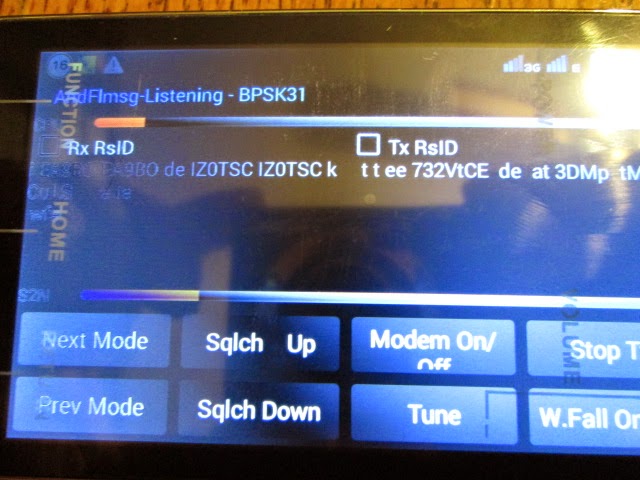
This now opens the door to cheap home and portable operation, using FLDIGI's modes likes PSK31 etc. Using simple Android tablets and Android PCs available from the likes of ebay for less than £50!
My 7" Android PC below, which should be suitable for use with FLDIGI.

Download the APK file, manual, and other details from here.
The software seems to cover many of the same functions, and modes, as its big brother Windows version.
I have only had a short time to play around with this tonight, but soon after I downloaded the APK on to my phone, a quick easy configure it was up and running within 5 minutes.
This now opens the door to cheap home and portable operation, using FLDIGI's modes likes PSK31 etc. Using simple Android tablets and Android PCs available from the likes of ebay for less than £50!
My 7" Android PC below, which should be suitable for use with FLDIGI.
Subscribe to:
Posts (Atom)